
EICR Codes: C1, C2, C3 and FI
See what each observation code means and answer four questions to find the code for what you found.
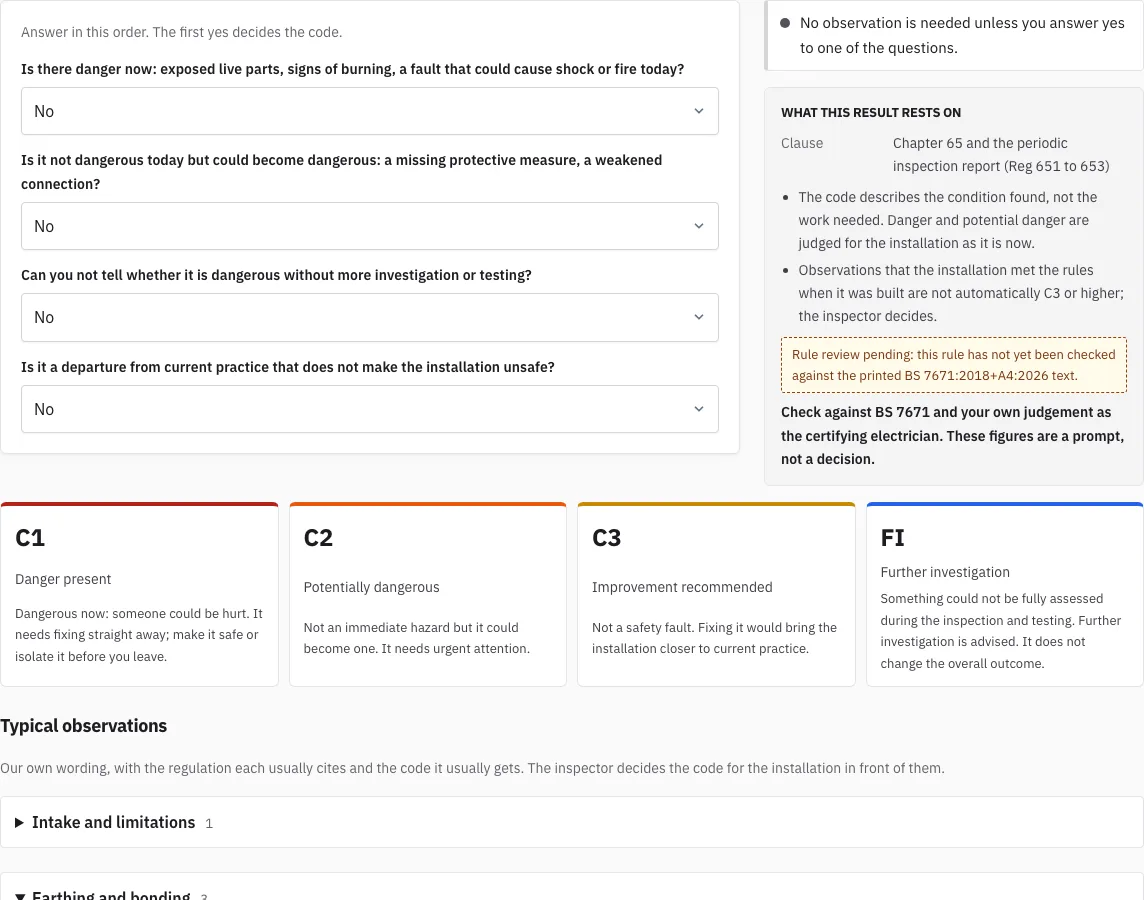
No observation is needed unless you answer yes to one of the questions.
- C1Danger presentDangerous now: someone could be hurt. It needs fixing straight away; make it safe or isolate it before you leave.
- C2Potentially dangerousNot an immediate hazard but it could become one. It needs urgent attention.
- C3Improvement recommendedNot a safety fault. Fixing it would bring the installation closer to current practice.
- FIFurther investigationSomething could not be fully assessed during the inspection and testing. Further investigation is advised. It does not change the overall outcome.
Typical observations
Our own wording, with the regulation each usually cites and the code it usually gets. The inspector decides the code for the installation in front of them.
Intake and limitations 1
- FIPart of the installation could not be inspected or tested and might be unsafe.
Earthing and bonding 3
- C1Earthing conductor missing, disconnected or not continuous.
- C2Main protective bonding missing to a service pipe or other extraneous conductive part.
- C2Protective bonding conductor smaller than the minimum size for the installation.
Protection and consumer unit 4
- C2Socket-outlets rated up to 32 A without 30 mA RCD additional protection.
- C2Circuits serving a bath or shower room without 30 mA RCD additional protection.
- C2Protective device rating too high for the cable it protects.
- C3Consumer unit in a dwelling not in a non-combustible enclosure.
Wiring systems 3
- C2Signs of overheating or arcing at a connection or accessory.
- C2Cable concealed in a wall or partition within 50 mm of the surface with no RCD protection and no earthed metal covering.
- C3Cables not adequately supported, sagging or rubbing.
Accessories and enclosures 1
- C1Live parts accessible to touch: missing blanks, broken faceplate or damaged enclosure.
Labelling and documents 3
- C3No circuit chart or schedule at the distribution board.
- C3No notice telling users to test the RCD regularly.
- C3No "Safety electrical connection" label at a bonding connection.
Test results 3
- C2Measured earth fault loop impedance too high for the protective device to disconnect in the required time.
- C2Reversed polarity found at an accessory or at the origin.
- FIInsulation resistance below the minimum and the cause is not yet found.
Free · runs in your browser · nothing is uploaded
How to use the EICR codes helper
- Open the library and choose the group that matches your finding: intake and limitations, earthing and bonding, protection and consumer unit, wiring systems, accessories and enclosures, labelling and documents, or test results.
- Open the observation that fits. It shows the usual code .
- If nothing fits, start the helper’s first question: is there danger now? Choose No, Yes or Not sure.
- If the answer is Yes, that sets the code and you stop there.
- If the answer is No, move to the next question: could it become dangerous? Then ask whether you can tell without more investigation, and finally whether it is a departure from current practice that does not make the installation unsafe.
- If you are unsure at any step, treat the finding as FI until it has been checked.
- Press Copy to take the code, text and regulation for that finding.
Copy each finding as you go.
The helper’s answers are only for the one finding in front of you; change them for the next finding. Use “Not sure” honestly: the page treats it as a reason to handle the finding as FI until it has been checked. When a finding fits an observation in the library, copy that wording and edit it to describe what you actually saw, where it was and how far it extended, so that the person reading the report can act on it.
What do C1, C2, C3 and FI mean?
Each finding on an EICR gets one of four codes. C1 means danger present, and it needs fixing straight away. C2 means potentially dangerous, needing urgent attention. C3 means improvement recommended, not a safety fault. FI means further investigation: something could not be fully assessed from the inspection and testing done, and further investigation is advised. C3 and FI do not change the overall outcome of the report. The code classification is the one on the model EICR form; the IET publishes its own model forms and a Wiring Matters article on further investigation under BS 7671:2018+A4:2026.
| Code | Meaning | What it asks for |
|---|---|---|
| C1 | Danger present | Someone could be hurt now. Fix it straight away, or make it safe or isolate it before leaving. |
| C2 | Potentially dangerous | Not an immediate hazard, but it could become one. Needs urgent attention. |
| C3 | Improvement recommended | Not a safety fault. |
| FI | Further investigation | Could not be fully assessed from the inspection and testing. Further investigation is advised. It does not change the overall outcome. |
C1 and C2 make a periodic report unsatisfactory. C3 alone does not. Periodic reporting sits in BS 7671 Chapter 65 (Reg 651 to 653).
How is the code chosen?
The helper asks four questions in a fixed order, and the first Yes sets the code. A Yes to “is there danger now” gives C1 whatever the later questions would say. If you are unsure, the finding is treated as FI until it is checked.
The library shows typical codings. For example, live parts accessible to touch is usually C1, and main protective bonding missing is usually C2. A typical coding is not a ruling. The code an inspector gives is professional judgement, and each result here is a prompt for the certifying electrician, not a decision.
Typical observations and their usual codes
The library in the tool holds 18 typical observations in our own words, grouped as intake and limitations, earthing and bonding, protection and consumer unit, wiring systems, accessories and enclosures, labelling and documents, and test results. A few examples:
| Observation | Usual code |
|---|---|
| Live parts accessible to touch | C1 |
| Main protective bonding missing | C2 |
| Socket-outlets up to 32 A without 30 mA RCD protection | C2 |
| Consumer unit in a dwelling not in a non-combustible enclosure | C3 |
| No circuit chart at the board | C3 |
These are typical codings, not rulings; the inspector decides the code for the installation in front of them.
How this tool works and where the numbers come from
The code meanings are written in our own words from the classification used on the EICR model form; typical codings are examples and the inspector decides.
Sources
- BS 7671:2018+A4:2026 Requirements for Electrical Installations (IET Wiring Regulations): publisher page, bibliographic reference; not checked against the printed text (BS 7671:2018+A4:2026) · checked
- IET: model forms for BS 7671 (the IET's own free page; WiringCert does not reproduce them) (BS 7671:2018+A4:2026 model forms) · checked
- IET Wiring Matters, July 2026: Implications of BS 7671:2018+A4:2026 on EICRs, further investigation (read) (Wiring Matters, Issue 110, July 2026) · checked
- IET Guidance Note 3: Inspection & Testing (publisher listing), bibliographic reference for recommended inspection intervals; not checked against the printed text (10th Edition) · checked
Frequently asked questions
What makes an EICR unsatisfactory?
Any C1 or C2 code makes a periodic report unsatisfactory. A C3 on its own does not, so a report with only improvement items can still be satisfactory.
Should a customer fix a C3?
The report does not require it, because C3 means improvement recommended rather than a safety fault. Whether to act is the customer’s choice, and the inspector’s judgement is what the report records.
Is a code 3 playing it safe?
A C3 recommends an improvement. It does not warn of danger, so it does not mean the installation is unsafe. Where the installation met the rules when it was built, a departure from current rules is not automatically a C3 or higher, and the inspector decides.
Is a C3 ever worth acting on?
Often, especially when work is already happening. A consumer unit in a dwelling that is not in a non-combustible enclosure is a typical C3, and a customer who is replacing the board anyway gets that improvement without an extra visit. Whether to act is still the customer’s decision.
Is there a limit to C3 codes?
No. A report can carry any number of C3 codes, and none of them makes the report unsatisfactory on its own.
How long is an EICR valid for?
The report states a recommended date for the next inspection. That is normally ten years for an owner-occupied home and five years for a rented one, or at change of occupancy. See How Long Is an EICR Valid For? for more.
Does an EICR cover my appliances?
No. An EICR covers the fixed installation: the cables, the consumer unit, the accessories, and the earthing and bonding. Appliances are not part of that list.
Related tools
- EICR Certificate Maker: use it when you need to produce the certificate for a completed inspection.
- EICR Report: Overall Assessment: use it when you want to see how the codes add up to an overall result.
- EICR Checklist: use it to go through the items before or after an inspection.
- How Long Is an EICR Valid For?: use it when you need the recommended date for the next inspection.
- Maximum Zs Values for MCBs and RCBOs: use it when a finding involves earth fault loop impedance and you need the limits for the protective device.
- Which Electrical Certificate Do I Need?: use it to check the report is the right document for the job.