
How Long Is an EICR Valid For?
Choose the premises and the date of the last inspection to see when the next one is due.
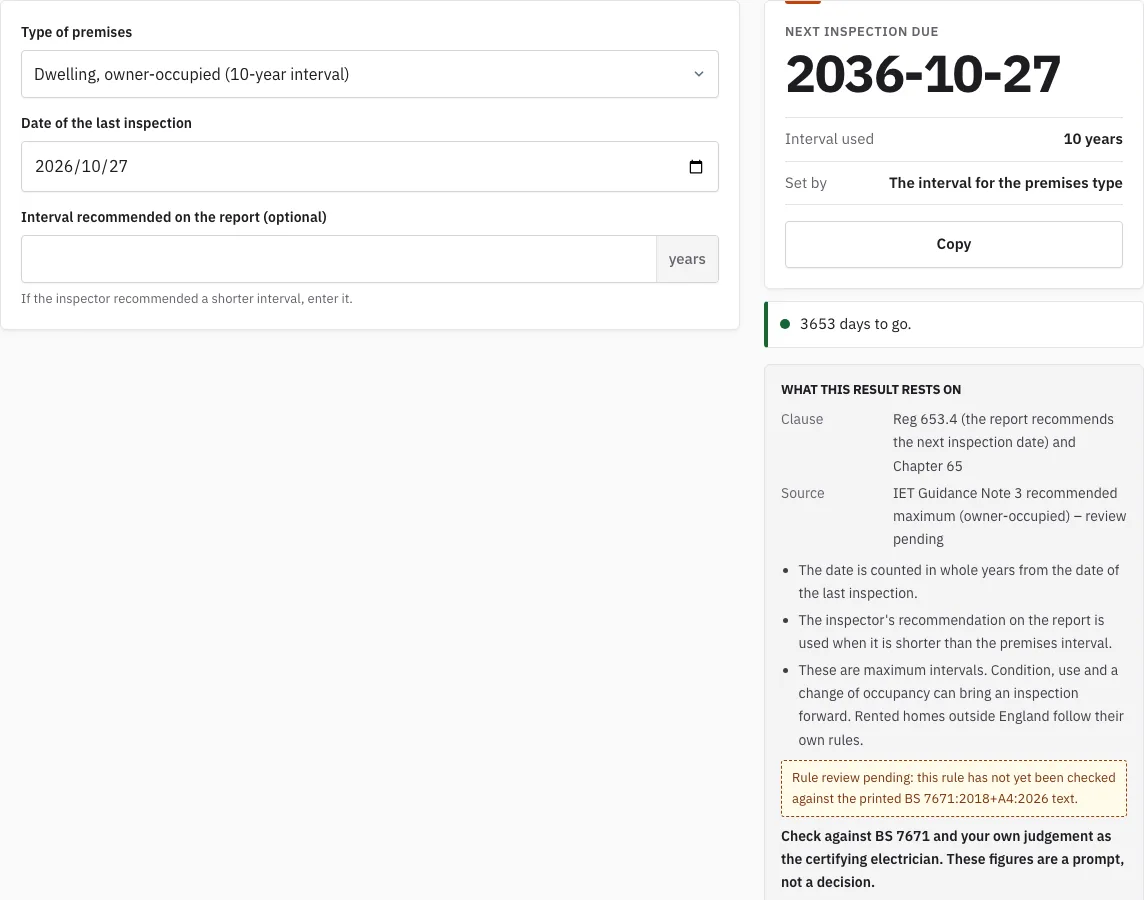
Next inspection due
- Interval used
- 10 years
- Set by
- The interval for the premises type
3652 days to go.
Free · runs in your browser · nothing is uploaded
How to use the EICR Next Inspection Date Calculator
- Choose the premises type that matches the property. The options are dwelling, privately rented home in England, Wales or Scotland, commercial, industrial, agricultural and horticultural, caravan park, swimming pool and other.
- Enter the date of the last inspection. The calculator counts whole years forward from this date.
- If the report gives a recommended interval, enter it. The calculator uses it only when it is shorter than the premises interval, because a longer figure never extends the maximum.
- If you chose “other”, enter the interval you need the calculator to use.
- Read the result. It shows the next inspection date, the interval used, and the status.
The status line reads “Overdue by” a number of days, “Due in” a number of days when 90 days or fewer remain, or shows the days to go when more time is left. Check the interval used first, because it tells you which limit the result is based on. If you are unsure which premises type applies, start with the type that describes the main use of the building.
Change any entry and the date updates straight away; nothing is stored, but the link in the address bar keeps your choices. Use the date the inspection was carried out, which the report states. For a rented home in England, treat the result as the latest date by which the next report must exist.
How Long Is An EICR Valid For?
An EICR does not carry an expiry date of its own. How long it stays current depends on the type of premises, with maximum intervals running from one year for caravan parks and swimming pools to ten years for owner-occupied dwellings. Privately rented homes in England are the case we have checked against the legislation itself: the maximum is five years, or sooner if the report says so. The other presets are marked “rule review pending” until they have been checked against the guidance note.
| Premises type | Maximum interval | Notes |
|---|---|---|
| Dwelling, owner-occupied | 10 years | IET Guidance Note 3 recommended maximum; rule review pending |
| Privately rented home in England | 5 years | Set by law (SI 2020/312, reg 3); sooner if the report says so |
| Social rented home in England | 5 years | The same rule has been extended to social housing by SI 2025/1043 (in force from 2025-11-01 and 2026-05-01); rule review pending |
| Privately rented home in Wales | 5 years | Rule review pending |
| Privately rented home in Scotland | 5 years | Rule review pending |
| Commercial | 5 years | |
| Industrial | 3 years | |
| Agricultural and horticultural | 3 years | |
| Caravan park | 1 year | |
| Swimming pool | 1 year | |
| Other | You enter the interval |
The report itself recommends the date of the next inspection (Reg 653.4), and these maximum intervals are the starting point for that recommendation. Check the current edition of IET Guidance Note 3 for premises not listed here. Condition, use and a change of occupancy can bring an inspection forward. Rented homes outside England follow their own rules.
How Is The Next Inspection Date Worked Out?
The calculator starts from the date of the last inspection and adds the interval in whole years. If the report recommends a shorter interval, that shorter figure replaces the premises interval. A date of 29 February moves to 28 February in a non-leap year.
- Take the date of the last inspection.
- Add the premises interval in whole years.
- If the report gives a shorter recommended interval, use that instead.
- If the result falls on 29 February in a non-leap year, use 28 February.
The result is a prompt for the certifying electrician to review, not a decision on the installation’s safety. Treat the date as the point by which the next check should be done.
How this tool works and where the numbers come from
Intervals are the maxima recommended in IET Guidance Note 3 and, for private rented homes in England, the five years in the 2020 regulations.
Sources
- BS 7671:2018+A4:2026 Requirements for Electrical Installations (IET Wiring Regulations): publisher page, bibliographic reference; not checked against the printed text (BS 7671:2018+A4:2026) · checked
- The Electrical Safety Standards in the Private Rented Sector and Social Rented Sector (England) Regulations 2020, SI 2020/312, current text (reg 3 read) (latest available (revised) text on legislation.gov.uk) · checked
- GOV.UK: Electrical safety standards in the private rented sector, guidance for landlords, tenants and local authorities (published 1 November 2025) · checked
- IET Guidance Note 3: Inspection & Testing (publisher listing), bibliographic reference for recommended inspection intervals; not checked against the printed text (10th Edition) · checked
- SI 2025/1043, Electrical Safety Standards in the Private Rented Sector (England) (Amendment) (Extension to the Social Rented Sector) Regulations 2025 (contents and reg 1 read) (latest available (revised) text on legislation.gov.uk) · checked
Frequently asked questions
What is an EICR?
An EICR, or Electrical Installation Condition Report, is the written record of an electrician’s inspection and testing of a fixed electrical installation. It describes the condition of the wiring and fittings and lists any faults found, each with a code. You can read what each code means on the EICR Codes page.
What happens during an EICR?
The electrician inspects the fixed installation, including the consumer unit, wiring and sockets, and runs tests. Anything unsafe or not meeting BS 7671 is recorded against a code. A C1 code means danger is present, with immediate risk of injury, and urgent remedial action is needed.
Do I need an EICR?
Private landlords in England must have a current EICR for rented homes, and the law sets a five-year maximum. For an owner-occupied home, the recommended maximum is 10 years, and it can come sooner after a change of occupancy. Enter your property type in the calculator to see its date.
What happens when the date passes?
For an owner-occupied home, the date on the report is a recommendation rather than a hard expiry, and the installation should be inspected again. For a privately rented home in England, the five-year maximum is set by law in the 2020 regulations, and a landlord who lets without a current report is in breach of them.
Do I need a new EICR for every new tenant?
Not automatically: a report that is still within its period can stay in use. A change of occupancy can bring the next inspection forward, so check the date after each change of tenant, and follow the rules that apply to your type of tenancy.
Related tools
- EICR Certificate Maker: use it when you need to draft the certificate after an inspection.
- EICR Codes: C1, C2, C3 and FI: use it when you need to understand what a code on the report means.
- EICR Report: Overall Assessment: use it when you want to work out the overall result from the observations.
- EICR Checklist: use it when you are preparing for an inspection and want to cover each item.
- Maximum Zs Values for MCBs and RCBOs: use it when you are checking earth fault loop impedance against circuit protection limits.
- Which Electrical Certificate Do I Need?: use it to confirm that an EICR is the document you need.