
Insulation Resistance Test: Test Voltage and Minimum
Choose the circuit voltage to see the test voltage and the minimum, and check your reading.
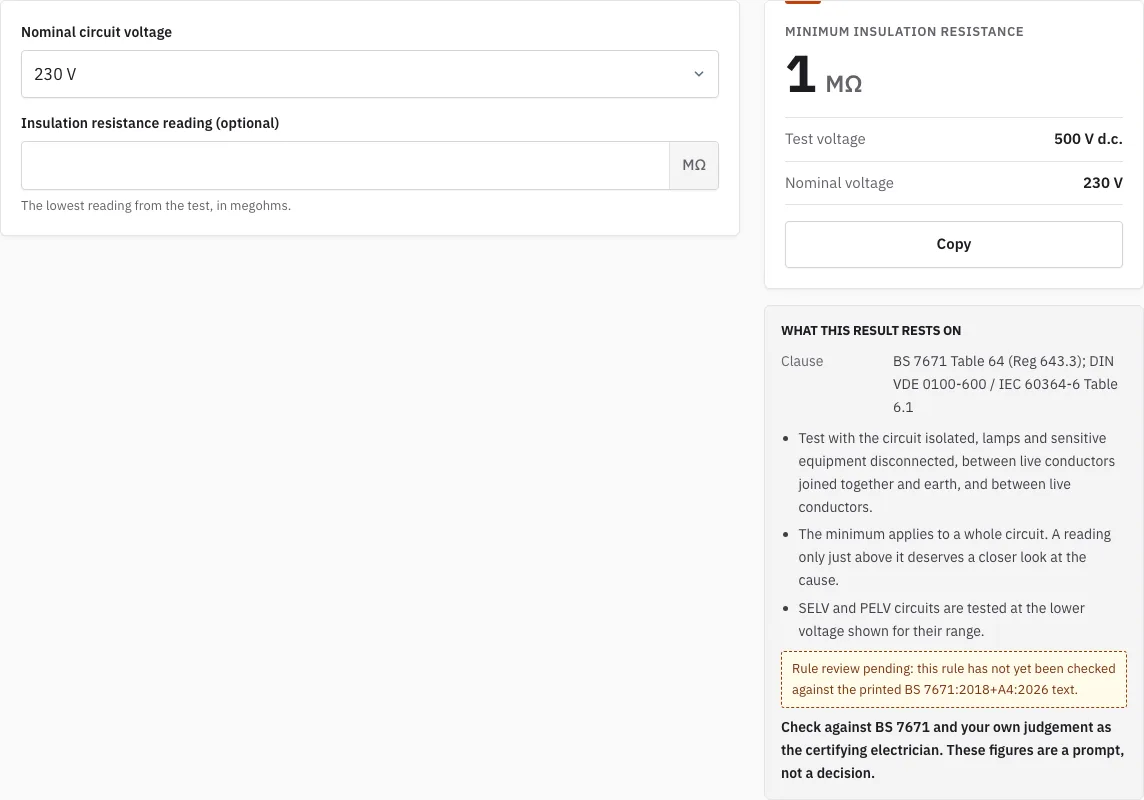
Minimum insulation resistance
MΩ
- Test voltage
- 500 V d.c.
- Nominal voltage
- 230 V
Free · runs in your browser · nothing is uploaded
How to use the Insulation Resistance Test
- Choose the nominal circuit voltage from the list: 24, 50, 120, 230, 400, 690 or 1000 V.
- If your circuit uses a different voltage, type it in instead.
- Read the insulation test voltage the page returns for that circuit.
- Note the minimum insulation resistance shown beside it.
- Carry out your test on the circuit, then enter your reading if you want a pass or fail result.
- Check the result. A reading below the minimum fails.
- If the page warns that the test voltage you recorded is below the expected value, check your test voltage before relying on the result.
Entering a reading is optional, so you can use the page just to look up the test voltage and minimum for a circuit before you start testing. The link in the address bar keeps your entries.
If you pick a voltage that is not in the list, type it in and the page chooses the band for you. Entering a reading is optional. If you do enter one, use the lowest reading you took on the circuit, in megohms, because a single low reading is what decides a pass or fail. Many testers show values above 200 megohms as a greater-than sign; type 200 in that case.
Which test voltage do I use?
The test voltage depends on the nominal circuit voltage. BS 7671 Table 64 (Regulation 643.3) sets it: SELV and PELV circuits are tested at 250 V d.c., circuits up to 500 V at 500 V d.c., and circuits above 500 V up to 1000 V at 1000 V d.c. Each band has its own minimum insulation resistance.
| Circuit type | Test voltage (d.c.) | Minimum insulation resistance |
|---|---|---|
| SELV and PELV | 250 V | 0.5 megohm |
| Up to 500 V, including 230 V and 400 V | 500 V | 1 megohm |
| Above 500 V up to 1000 V | 1000 V | 1 megohm |
The minimum applies to a whole circuit. A reading only just above it deserves a closer look at the cause before you accept it.
How do you test insulation resistance?
Isolate the circuit first, then disconnect lamps and sensitive equipment. Take readings between the live conductors joined together and earth, and between the live conductors themselves. Compare each reading with the minimum for that circuit, using the test voltage from the table above.
- Isolate the circuit so it is dead and cannot be switched back on during the test.
- Disconnect lamps and sensitive equipment from the circuit.
- Set the test voltage for the circuit band from the table.
- Test between the live conductors joined together and earth.
- Test between the live conductors.
- Compare each reading with the minimum insulation resistance for the circuit.
Every result is a prompt for the certifying electrician, not a decision. Pass the readings to them with the rest of your test record.
Which circuits fall in which band?
The page offers seven nominal voltages. 24 V and 50 V circuits are extra-low voltage, so they sit in the SELV and PELV band: 250 V d.c. test, 0.5 megohm minimum. 120 V, 230 V and 400 V circuits are up to 500 V: 500 V d.c. test, 1 megohm minimum. 690 V and 1000 V are above 500 V and up to 1000 V: 1000 V d.c. test, 1 megohm minimum. If your voltage is not in the list, type it in and the page puts it in the right band.
How this tool works and where the numbers come from
Test voltages and minimum values are those of BS 7671 Table 64 (Regulation 643.3).
Sources
Frequently asked questions
Why test insulation resistance?
Insulation testing confirms that cables, wiring, motors and other electrical equipment still have the electrical integrity they need to be safe. It shows problems in the insulation before they become a shock risk.
What does an insulation resistance tester measure?
It measures insulation resistance, in megohms. It applies a d.c. test voltage and reads the small leakage current that passes through the insulation.
What is an acceptable reading?
An acceptable reading is one at or above the minimum insulation resistance for that circuit. For a 230 V circuit tested at 500 V d.c., the minimum is 1 megohm, so 200 megohms passes and 0.4 megohm fails.
What is the normal insulation resistance?
There is no single normal figure, because the minimum depends on the circuit band. SELV and PELV circuits need at least 0.5 megohm, and circuits up to 1000 V need at least 1 megohm.
What if the reading is below the minimum?
The circuit fails this test. Find the cause before retesting: disconnect equipment you may have missed, then test sections of the circuit to narrow down where the leakage is. The page marks the reading as below the minimum and nothing more; the certifying electrician decides what to record.
Does the page store my readings?
No. Entries stay in the address bar link only if you copy it; nothing is saved or sent. For a record of the test, use the schedule of test results.
Related tools
- EICR Certificate Maker: use it to record your inspection results in one place.
- EICR Codes: C1, C2, C3 and FI: use it to check which observation code fits a defect you have found.
- RCD Test: Trip Time Checker: use it when you need to check RCD trip times alongside your insulation readings.
- Ring Final Circuit Test Calculator: use it when you are checking a ring final circuit.
- Earth Fault Loop Impedance Calculator: use it to work out earth fault loop impedance for a circuit.
- Maximum Zs Values for MCBs and RCBOs: use it to look up the maximum Zs for a protective device.
- Earth Electrode Resistance (Ra) Checker: use it when you are checking the resistance of an earth electrode.