
Prospective Fault Current Calculator
Enter an impedance or the tester reading and see whether the device can break the current.
Enter the impedance, or the tester's reading in kA.
Free · runs in your browser · nothing is uploaded
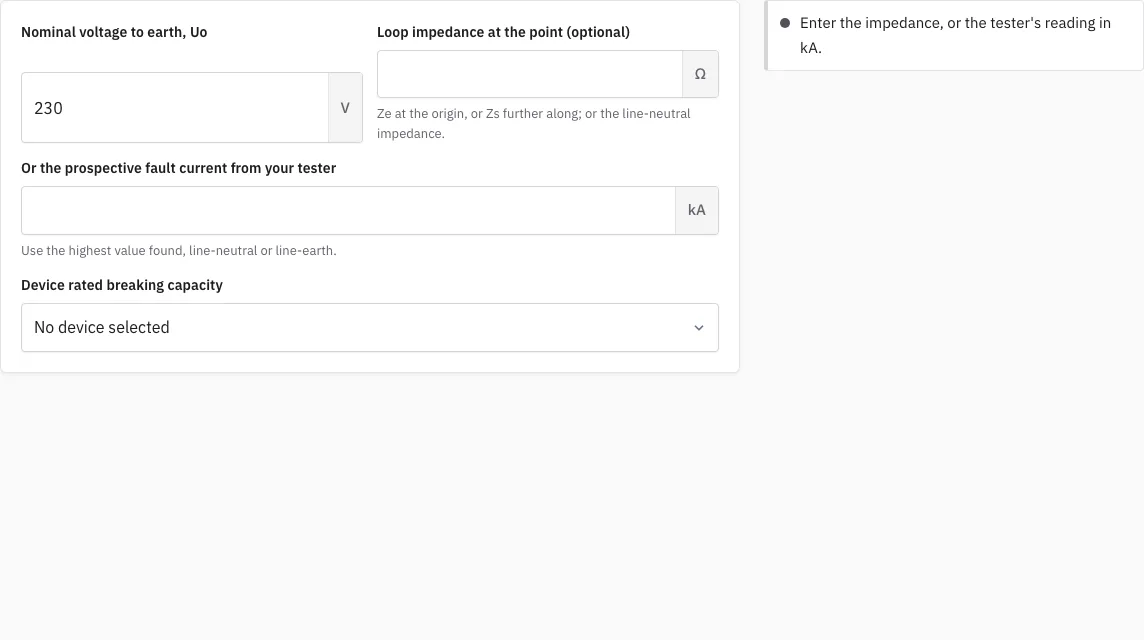
How to use the prospective fault current calculator
- Check the Uo field first. It is set to 230 V by default, which is the voltage to earth. Change it if your nominal voltage to earth is different.
- Enter a loop impedance in ohms. If your tester shows a prospective fault current in kA instead, enter that value in the kA field rather than a loop impedance.
- Read the result. The page returns the prospective fault current in kA and in amperes, so you can use whichever unit your paperwork uses.
- Choose the rated breaking capacity from the list: 1.5, 3, 4.5, 6, 10, 15, 20 or 25 kA. Pick the value marked on the device in front of you. The list is there for convenience, so check your device before you rely on it.
- Read the message that says whether the prospective fault current is within the breaking capacity you chose. If it is not, the device is not rated for the current at that point.
If you have both an impedance and a tester reading, the reading wins and the impedance is ignored. Check that you entered kA, not amperes, in the kA field: 0.66 means 660 amperes. The link in the address bar keeps your entries so that you can come back to the same calculation.
What is prospective fault current?
Prospective fault current, often shortened to pfc, is the largest current that could flow at a point in a circuit if a fault short-circuited it. Prospective short circuit current (PSCC) is the same idea for a short circuit between line and neutral.
For a breaking-capacity check, use the worst case: the larger of the line-neutral and line-earth values, which is usually found at the origin of the installation. Enter the impedance or the tester reading for that one. The current is the voltage divided by the loop impedance, so a low loop impedance gives a high prospective fault current. Every result is a prompt for the certifying electrician, not a decision.
How do I calculate the prospective fault current?
Divide the nominal voltage to earth, Uo, by the loop impedance in ohms, and the answer is the prospective fault current in amperes. The tool does this sum for you and also shows the result in kA. Uo is the voltage between line and earth, so on a three-phase system you use the line-to-earth value too.
- Find Uo. The tool uses 230 V by default.
- Find the loop impedance in ohms from your loop test at the point you are checking.
- Use the impedance behind the larger of the line-neutral and line-earth currents, because that is the worst case.
- Divide Uo by the loop impedance to get the current in amperes.
- Read the kA figure the tool shows and compare it with the breaking capacity of your device.
Worked example: 230 V divided by 0.35 ohm is 657 A, which is 0.66 kA.
What values should I expect?
The sum is only Uo divided by the impedance, so the current rises as the impedance falls. At 230 V, these impedances give:
| Loop impedance | Prospective fault current |
|---|---|
| 1.00 ohm | 230 A (0.23 kA) |
| 0.50 ohm | 460 A (0.46 kA) |
| 0.35 ohm | 657 A (0.66 kA) |
| 0.20 ohm | 1150 A (1.15 kA) |
These values are far below the preferred breaking capacities of 1.5 kA and up, so a device of 1.5 kA or more passes at these points; the check matters most near the origin of a large supply, where the impedance is a fraction of an ohm and the current is much higher.
How this tool works and where the numbers come from
Prospective fault current is Uo divided by the loop impedance; the breaking-capacity requirement is Regulation 434.5.1 of BS 7671.
Sources
Frequently asked questions
Why would I want to know the PSCC?
If the breaking capacity of a protective device is too low for the fault current at its position, the current may destroy the device or cause an electric arc. Knowing the PSCC lets you choose a device whose rating is high enough for that point.
Which breaking capacity values can I choose?
The page offers the preferred miniature circuit-breaker values of 1.5, 3, 4.5, 6, 10, 15, 20 and 25 kA. Choose the value marked on your device, and the page tells you whether the current is within it.
What does BS 7671 require for breaking capacity?
Regulation 434.5.1 of BS 7671 asks for a rated breaking capacity not less than the prospective fault current at the point of installation. The exception is where a back-up device protects that point. This site works to the BS 7671:2018+A4:2026 version.
What is the difference between PSCC and PEFC?
PEFC is the prospective earth fault current, the line-to-earth figure. The line-to-neutral figure is the prospective short circuit current. The page does the same sum for either, so enter the impedance for the one you are checking.
Does the page need an impedance, or can I enter the current?
Either. Enter an impedance and the page divides Uo by it, or enter the kA reading from your tester and the page uses that directly. The link in the address bar keeps your entries.
Related tools
- Earth Fault Loop Impedance Calculator: use it to work out the loop impedance you enter here.
- Maximum Zs Values for MCBs and RCBOs: use it to compare your measured loop impedance against the limits for each device.
- Max Zs Calculator: use it to find the maximum permitted earth fault loop impedance for a circuit.
- EICR Certificate Maker: use it to record your inspection results on a certificate.
- EICR Codes: C1, C2, C3 and FI: use it to look up the observation codes that apply to a finding.
- Ring Final Circuit Test Calculator: use it when you are testing a ring final circuit.
- Insulation Resistance Test: Test Voltage and Minimum: use it to check the test voltage and minimum reading for an insulation test.
- RCD Test: Trip Time Checker: use it to check whether an RCD trips within the time allowed.
- Earth Electrode Resistance (Ra) Checker: use it to check an earth electrode resistance reading.