
RCD Test: Trip Time Checker
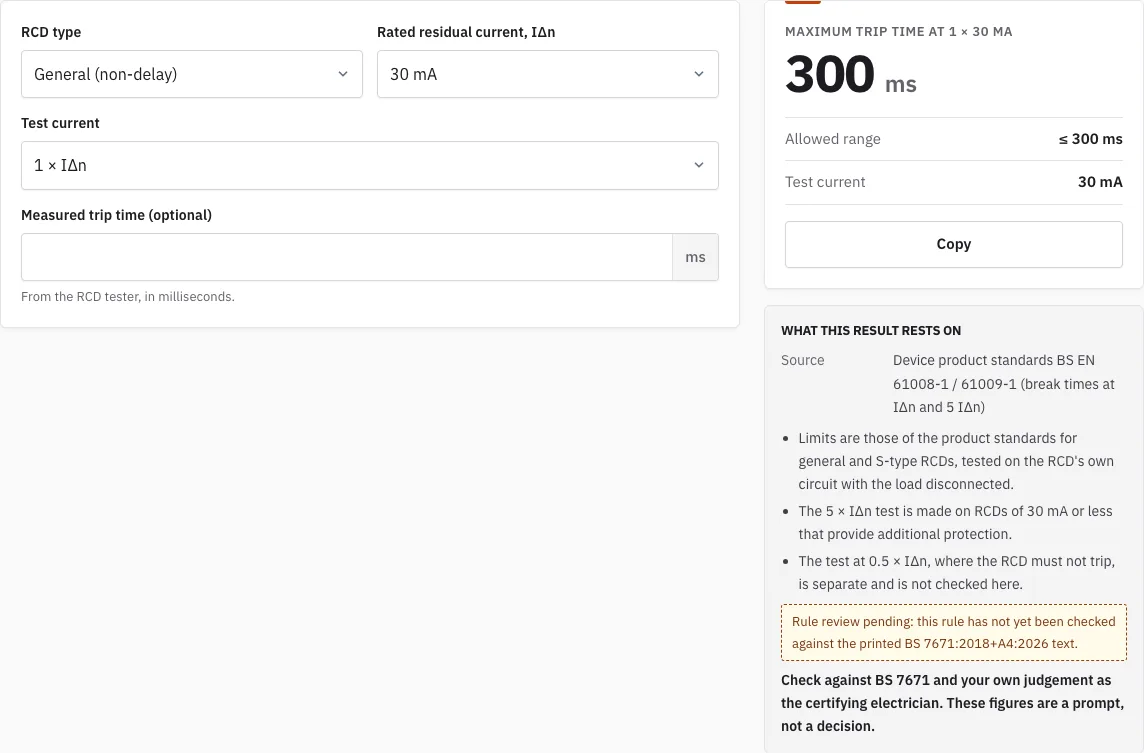
Pick the RCD type and the test current and check the trip time you measured.
Maximum trip time at 1 × 30 mA
ms
- Allowed range
- ≤ 300 ms
- Test current
- 30 mA
Free · runs in your browser · nothing is uploaded
How to use the RCD Test
- Choose the RCD type: general (non-delay) or S type (time-delayed).
- Select the rated residual current IΔn: 10, 30, 100, 300 or 500 mA.
- Select the test: 1 x IΔn or 5 x IΔn. The 5 x test is a product-standard test for RCDs of 30 mA or less that provide additional protection, so choose 1 x IΔn for the higher ratings. Whether BS 7671:2018+A4:2026 still asks for the 5 x test is under review.
- Read the maximum trip time and the allowed range the page shows for that combination of type, rating and test.
- Enter the trip time from your RCD tester so the page can check the reading.
- Read the outcome. A reading slower than the maximum fails. A reading within the range passes. For an S type, a reading quicker than the minimum is flagged, so check the RCD type and your test setup before going further.
Use the type and the rated residual current printed on the RCD you tested, not the ones you expected. Read the allowed range before you test so that you know what the tester should show. If the reading is quicker than the minimum on an S type, check that you selected the S type and not the general type. The link in the address bar keeps your choices and your reading.
What is RCD testing?
RCD testing checks that a residual current device trips, and cuts the supply, within the time limits set for it. A tester applies a set residual current to the RCD and times how long it takes to open the circuit. The tests are those of BS 7671 Chapter 64.
Trip time is the figure that matters most. It is the time from the test current being applied to the RCD disconnecting. A general RCD has a maximum limit only. An S type has both a minimum and a maximum, because it is built to wait briefly before tripping, so a reading that is too quick can be as much of a concern as one that is too slow.
This tool checks the trip time only. It does not cover the test at 0.5 x IΔn, where the RCD must not trip, and that check needs to be carried out separately.
What does the allowed range show?
For each combination of type, rated residual current and test, the page shows the longest trip time that passes and, for an S type, the shortest. The test current is the rated current times the test multiple, so a 30 mA RCD at 5 x is tested at 150 mA. The page shows that current so you can set your tester to it.
Do you test an RCD at 1 x or 5 x IΔn?
Test at 1 x IΔn on any RCD. The 5 x IΔn test is a product-standard test for RCDs of 30 mA or less that provide additional protection; whether BS 7671:2018+A4:2026 still asks for it is under review. Each test has its own trip time limit, so a device can pass one and fail the other.
| Test | Test current (30 mA RCD) | General RCD limit | S type allowed range |
|---|---|---|---|
| 1 x IΔn | 30 mA | Must trip within 300 ms | Between 130 and 500 ms |
| 5 x IΔn | 150 mA | Must trip within 40 ms | Between 50 and 150 ms |
These limits come from the RCD product standards BS EN 61008-1 and BS EN 61009-1. Each result is a prompt for the certifying electrician, not a decision, so read it alongside the rest of the installation checks.
How this tool works and where the numbers come from
Trip-time limits follow the RCD product standards (BS EN 61008-1 and 61009-1); the tests are those of BS 7671 Chapter 64.
Sources
- BS 7671:2018+A4:2026 Requirements for Electrical Installations (IET Wiring Regulations): publisher page, bibliographic reference; not checked against the printed text (BS 7671:2018+A4:2026) · checked
- IEC 61008-1 (BS EN 61008-1): residual current operated circuit-breakers without overcurrent protection, bibliographic reference for RCD trip times (Edition 4.0, published 2024-11-21) · checked
- IEC 61009-1 (BS EN 61009-1): RCBOs, bibliographic reference for RCD trip times and tripping curves (Edition 4.0, published 2024-11-21) · checked
Frequently asked questions
What does RCD stand for?
RCD stands for Residual Current Device. It is the protective device that cuts the supply when the current going out on the live wire and the current coming back on the neutral no longer match.
How does an RCD work?
Both the live and neutral wires pass through the RCD, which compares the current in each. Under normal use the two balance, but a leak to earth upsets that balance, and the RCD trips to disconnect the circuit.
What is an RCD tester?
An RCD tester is an instrument that applies a controlled residual current to an RCD and measures how long it takes to trip. This tool does not replace that instrument; it checks the reading you get from it against the limits.
Is an RCD tester the same as a loop tester?
No. An RCD tester checks how an RCD trips; a loop tester measures earth fault loop impedance. They are different checks, and many multifunction testers do both.
What is RCD trip time?
RCD trip time is how long the RCD takes to disconnect the supply after the test current is applied. For a 30 mA general RCD, the maximum is 300 ms at 1 x IΔn (30 mA) and 40 ms at 5 x IΔn (150 mA).
What do RCD test results mean?
A pass means the trip time sits within the allowed range. A fail means the RCD is slower than the maximum. An S type reading quicker than its minimum is flagged, so check the RCD type and test setup before you decide.
What if the RCD fails the test?
A trip time above the maximum is a fail. Check the connections and the test setup, then repeat the test. If it still fails, the RCD is not doing its job and the certifying electrician decides what to record and what to replace.
Does the page store my readings?
No. Entries stay in the address bar link only if you copy it. For a record of the test, use the schedule of test results.
Related tools
- EICR Certificate Maker: Use it to record your inspection findings once your RCD results are in.
- EICR Codes: C1, C2, C3 and FI: Use it to look up the observation code that fits a fault you have found.
- Maximum Zs Values for MCBs and RCBOs: Use it to find the maximum earth fault loop impedance for a protective device.
- Max Zs Calculator: Use it to work out the maximum Zs for a circuit you are testing.
- Earth Fault Loop Impedance Calculator: Use it when you need to check the loop impedance alongside your RCD checks.
- Ring Final Circuit Test Calculator: Use it to check your ring final circuit readings before or after the RCD test.
- Insulation Resistance Test: Test Voltage and Minimum: Use it to confirm the test voltage and minimum reading for an insulation check.
- Earth Electrode Resistance (Ra) Checker: Use it when you are checking the resistance of an earth electrode.
- Prospective Fault Current Calculator: Use it to estimate the fault current available at a point in the installation.