
RCD Types: AC, A, F and B
Say what the circuit supplies and see which RCD type it needs.
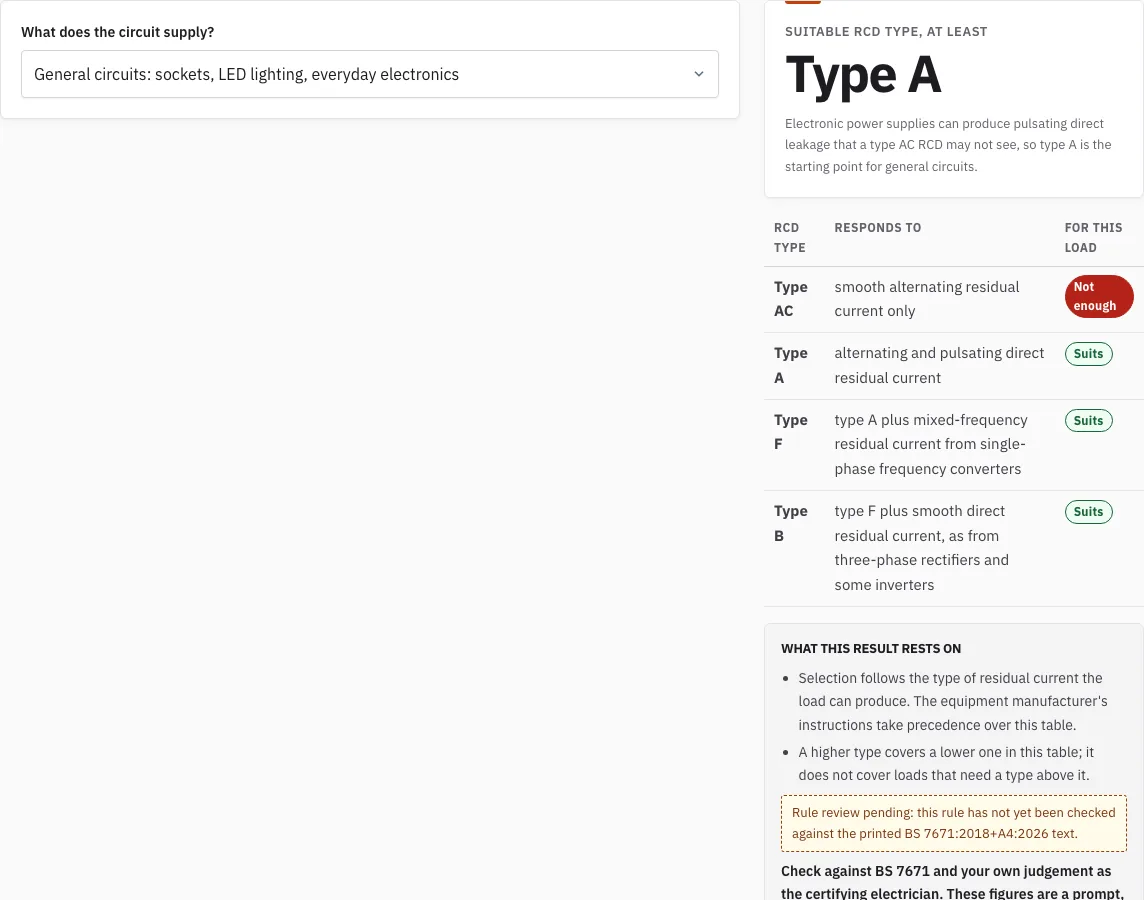
Suitable RCD type, at least
Type A
Electronic power supplies can produce pulsating direct leakage that a type AC RCD may not see, so type A is the starting point for general circuits.
| RCD type | Responds to | For this load |
|---|---|---|
| Type AC | smooth alternating residual current only | Not enough |
| Type A | alternating and pulsating direct residual current | Suits |
| Type F | type A plus mixed-frequency residual current from single-phase frequency converters | Suits |
| Type B | type F plus smooth direct residual current, as from three-phase rectifiers and some inverters | Suits |
Free · runs in your browser · nothing is uploaded
How to use the RCD Types Tool
- Use the selector at the top of this page. Choose what the circuit supplies from the six options: resistive loads, general circuits, single-phase equipment with a frequency converter, three-phase variable-speed drive or rectifier, solar PV inverter without simple separation, or electric vehicle charge point.
- Read the minimum RCD type shown for that load.
- Check which other types suit the load. Each result lists the types that match the residual current the load can produce.
- Compare the result with the equipment manufacturer’s instructions. Those instructions take precedence. For an electric vehicle charge point, also check whether the charge point has direct-current detection built in.
To compare two circuits, pick the first load, note the result, then pick the second load and read its result. The link in the address bar keeps the load you chose.
The selector does not store anything. Change the load to see how the minimum type moves: a resistive load gives type AC as the minimum, general circuits type A, single-phase equipment with a frequency converter type F, and drives, rectifiers, PV inverters without separation and charge points type B or its equivalent. Always read the equipment’s own installation instructions as well.
What are the four types of RCD?
The four RCD types are AC, A, F and B. Each type is defined by the kind of residual current it can detect. Type AC detects smooth alternating residual current, type A also detects pulsating direct current, type F adds mixed-frequency current from single-phase frequency converters, and type B also detects smooth direct current.
| Type | What it detects | Result from the tool |
|---|---|---|
| AC | Smooth alternating residual current only | Resistive loads, though type A is still the usual choice |
| A | Alternating and pulsating direct residual current | General circuits |
| F | Mixed-frequency residual current from single-phase frequency converters, on top of what type A detects | Single-phase equipment with a frequency converter |
| B | Smooth direct residual current too, as from three-phase rectifiers and some inverters | Three-phase variable-speed drive, PV inverter without simple separation, electric vehicle charge point |
In the comparison table a higher type covers a lower one. A higher type does not cover loads that need a type above it. The selection follows the residual current waveform the load can produce: the type must suit the residual current waveform the load can produce. For an electric vehicle charge point the result is a type B RCD, or a type A RCD with a device that detects direct fault current in the charge point.
How do you tell if an RCD is type A or AC?
Read the type marking printed on the RCD itself. A type AC device is marked AC, and a type A device is marked A. If you cannot read a marking, do not assume the device is AC. Check the manufacturer’s documentation or ask the certifying electrician.
- Find the RCD in the consumer unit and look at its front face and side labels for the type marking.
- If it is marked AC, the device is type AC and detects smooth alternating residual current only.
- If it is marked A, the device is type A and also detects pulsating direct residual current.
- If the marking is missing or unreadable, look up the device in the manufacturer’s documentation before you rely on it.
- Compare the type you found with the minimum type the tool gives for the load.
How this tool works and where the numbers come from
RCD type selection follows the residual current waveform the load can produce (BS 7671, with the manufacturer’s instructions taking precedence).
Sources
- BS 7671:2018+A4:2026 Requirements for Electrical Installations (IET Wiring Regulations): publisher page, bibliographic reference; not checked against the printed text (BS 7671:2018+A4:2026) · checked
- IEC 61008-1 (BS EN 61008-1): residual current operated circuit-breakers without overcurrent protection, bibliographic reference for RCD trip times (Edition 4.0, published 2024-11-21) · checked
- IEC 61009-1 (BS EN 61009-1): RCBOs, bibliographic reference for RCD trip times and tripping curves (Edition 4.0, published 2024-11-21) · checked
Frequently asked questions
Which RCD type do I need for my circuit?
Choose the load the circuit supplies in the tool, and it shows the minimum RCD type for that load. For general circuits such as sockets, LED lighting and everyday electronics, the result is type A. The manufacturer’s instructions for the equipment still take precedence.
Does a higher RCD type cover a lower one?
In the comparison table, a higher type covers a lower one. A type B RCD can therefore serve loads that need type A or type AC. A higher type does not cover loads that need a type above it, so a type A device will not meet a load whose result says type B.
Which RCD type is needed for an electric vehicle charge point?
The tool’s result for an electric vehicle charge point is a type B RCD, or a type A RCD with a device that detects direct fault current in the charge point. Some charge points have that direct-current detection built in and some do not, so check the charge point’s own instructions first.
Which RCD type suits a solar PV inverter?
For a solar PV inverter without simple separation, the tool’s result is usually a type B RCD. Check the inverter’s instructions as well, because the manufacturer’s instructions take precedence over the result.
Related tools
- RCD Test: Trip Time Checker: use it after you have chosen an RCD to check its trip time.
- EICR Certificate Maker: use it to record RCD results when you write up an inspection.
- EICR Codes: C1, C2, C3 and FI: use it when you need to grade a finding from an inspection.
- Earth Fault Loop Impedance Calculator: use it when you are checking earth fault loop impedance on the same circuit.
- Maximum Zs Values for MCBs and RCBOs: use it to look up the maximum Zs for an MCB or RCBO on a circuit.
- Insulation Resistance Test: Test Voltage and Minimum: use it for the insulation test of the same circuit.