
Which Electrical Certificate Do I Need?
Say what work was done and see which certificate goes with it.
You need
Electrical Installation Certificate (EIC)
A new circuit is more than minor works, so it is certified with an EIC.
In England and Wales some domestic work must also be notified to Building Control or through a competent person scheme (Part P). A certificate does not do that.
Free · runs in your browser · nothing is uploaded
This tool tells you which electrical certificate fits a piece of electrical work. You answer one question, “What work was done?”, and it points you to an Electrical Installation Certificate (EIC), a Minor Electrical Installation Works Certificate, an Electrical Installation Condition Report (EICR), or no certificate at all for a like-for-like accessory swap.
Each result comes with a button that opens the matching fill-in page for the EIC, Minor Works or EICR. Use it before you start the paperwork so you open the right form first time, especially when a job sits between two categories, such as adding a socket to a ring.
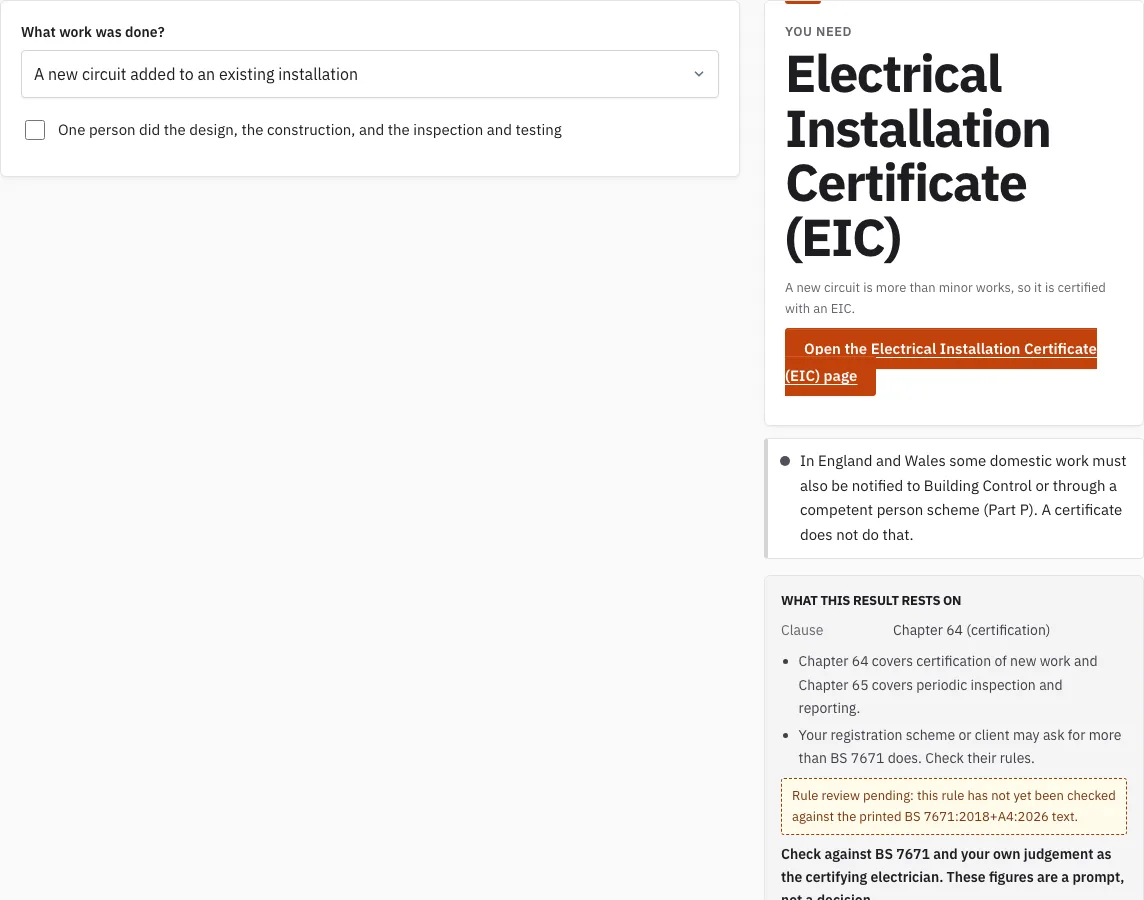
How to use the electrical certificate tool
- Read the question on the page: “What work was done?”
- Choose the answer that describes the main job. The seven options are a new installation; a new circuit added to an existing installation; a new consumer unit or distribution board; a change to an existing circuit that adds no new circuit, such as one more socket on a ring; replacing an accessory like for like; a periodic inspection of an existing installation; and an inspection for a sale, a tenancy or insurance.
- Read the result. It names one of four outcomes: an EIC, a Minor Works certificate, an EICR, or no certificate by default.
- If the result is an EIC, look at the tick box that asks whether one person did the design, the construction, and the inspection and testing. If it is ticked, the single-signature EIC is offered.
- Select the button under the result to open the matching fill-in page: the EIC, Minor Works or EICR page.
If the result says no certificate, the accessory swap usually needs none. A registration scheme, a client or an employer may still ask for a Minor Works certificate, so check before you skip it.
Change the answer and the result changes immediately; nothing is saved. If a job covers two things, such as a new circuit and a consumer unit change, the highest-level answer decides, so choose the new circuit or the consumer unit option and use an EIC.
What Is an Electrical Certificate?
An electrical certificate is the everyday name for a document that records electrical work or an inspection of it. The formal names are the Electrical Installation Certificate (EIC), the Minor Electrical Installation Works Certificate, and the Electrical Installation Condition Report (EICR). Phrases such as electrical safety certificate and electrical test certificate usually mean one of these three.
Which one you need depends on the job, not on which name sounds right. The page asks what work was done and matches the answer to one certificate.
Which Electrical Certificate Do I Need?
You need an Electrical Installation Certificate for a new installation, a new circuit, or a new consumer unit or distribution board. A Minor Works certificate covers an addition or alteration that creates no new circuit. An EICR covers periodic inspection, sale, tenancy and insurance checks. A like-for-like accessory swap usually needs no certificate by default.
| Work done | Certificate |
|---|---|
| New installation | Electrical Installation Certificate (EIC) |
| New circuit added to an existing installation | Electrical Installation Certificate (EIC) |
| New consumer unit or distribution board | Electrical Installation Certificate (EIC) |
| Change to an existing circuit that adds no new circuit (for example one more socket on a ring) | Minor Electrical Installation Works Certificate |
| Replacing an accessory like for like | No certificate by default |
| Periodic inspection of an existing installation | Electrical Installation Condition Report (EICR) |
| Inspection for a sale, a tenancy or insurance | Electrical Installation Condition Report (EICR) |
Which BS 7671 Rules Cover Each Certificate?
New work is certified under BS 7671 Chapter 64, Regulation 644. Periodic inspection and reporting falls under Chapter 65, Regulations 651 to 653. This site works to BS 7671:2018+A4:2026.
In practice, an EIC or Minor Works certificate follows the new-work rules, and an EICR follows the inspection rules. The result from this tool is a prompt for the certifying electrician to check the work against these rules, not a decision in its own right.
How this tool works and where the numbers come from
The choice follows the scope each model form in Appendix 6 of BS 7671 gives for itself (Chapters 64 and 65).
Sources
- BS 7671:2018+A4:2026 Requirements for Electrical Installations (IET Wiring Regulations): publisher page, bibliographic reference; not checked against the printed text (BS 7671:2018+A4:2026) · checked
- IET: model forms for BS 7671 (the IET's own free page; WiringCert does not reproduce them) (BS 7671:2018+A4:2026 model forms) · checked
Frequently asked questions
Is an electrical safety certificate the same as an electrical test certificate?
Both are everyday names for the documents covered on this page. The formal names are the EIC, the Minor Works certificate and the EICR, and the result names one of those three.
Do I need a certificate to replace a socket, switch or light fitting?
Usually not. A like-for-like swap of an accessory normally needs no certificate of its own, but a registration scheme, a client or an employer may still ask for a Minor Works certificate.
Does filling in a certificate notify Building Control?
No. In England and Wales some domestic work must be notified to Building Control or through a competent person scheme under Part P of the Building Regulations. A certificate does not do that notification, so arrange it separately.
What does the single-signature EIC tick box mean?
The tick box asks whether one person did the design, the construction, and the inspection and testing. If that is the case and you tick it, the single-signature EIC is offered. If not, the tool does not offer that version.
Can I use the result as the finished certificate?
No. Every result is a prompt for the certifying electrician, not a decision, so they still check the work before completing the certificate. The result button opens the matching fill-in page for the EIC, Minor Works or EICR.
Which certificate covers a sale, tenancy or insurance inspection?
An inspection for a sale, a tenancy or insurance gives an EICR. This is the same report used for a periodic inspection of an existing installation.
Related tools
- EICR Certificate Maker: use it to fill in an Electrical Installation Condition Report for periodic, sale, tenancy or insurance inspections.
- Electrical Installation Certificate (EIC): use it for a new installation, a new circuit or a new consumer unit.
- Minor Works Certificate: use it for an addition or alteration that creates no new circuit.
- EICR Certificate Template: use it if you want a template layout to check your EICR against.
- Minor Works Certificate Template: use it if you want a template layout for a Minor Works certificate.
- Schedule of Test Results: use it to record the test readings that support your certificate.
- EICR Codes: C1, C2, C3 and FI: use it when you need to check the observation codes used on an EICR.
- Maximum Zs Values for MCBs and RCBOs: use it when you need the maximum earth fault loop impedance values for protective devices.